Sauna While Pregnant: What the Medical Guidance Says
Major medical guidelines recommend avoiding sauna in the first trimester. Finnish, US, and UK guidance compared, plus the questions to bring to your provider.
This is one of the most-searched sauna questions, and one of the most-mishandled. Online answers range from blanket prohibitions ("never sauna while pregnant") to casual reassurance ("Finnish women have always done it"). Both miss the point. The real picture depends on which trimester, which type of sauna, what your medical history is, and which country's medical guidance you happen to be reading.
Before anything else: this is not medical advice. Pregnancy is the textbook case where a generic guide cannot replace a conversation with your obstetrician or midwife, who knows your specific history. Sauna safety in pregnancy depends on individual factors that an article can't assess. What this guide can do is summarize what the published medical guidance from major bodies actually says, what the evidence base behind that guidance looks like, and what questions to bring to your appointment.
The core concern: maternal hyperthermia
The medical concern with sauna in pregnancy isn't sauna itself. It's maternal core body temperature.
Multiple studies — most notably a 1992 Journal of the American Medical Association meta-analysis and follow-up work through the 2000s — have linked sustained maternal core temperature above 39°C (102.2°F) in the first trimester to an increased risk of neural tube defects, particularly anencephaly and spina bifida. The risk appears to be highest in weeks 4–8 of gestation, when the neural tube is forming.
The thresholds in the literature:
- Sustained core temperature above 39°C in the first trimester appears to increase neural tube defect risk.
- Brief temperature elevations (a hot bath, mild fever) have not been clearly linked to harm in normal pregnancies.
- Repeated elevation is a stronger signal than single elevation.
A Finnish sauna at 80–90°C can elevate core body temperature to 38–39°C within 15–20 minutes, particularly without adequate cool-down. That's the proximity to the threshold that drives the cautious guidance.
The picture for second and third trimester is different. Neural tube formation is complete by the end of the first trimester, and the main remaining concerns shift toward maternal cardiovascular load, dehydration, orthostatic hypotension (with risk of falls), and reduced uteroplacental blood flow with sustained heat exposure.
What the major guidelines say
The guidance varies meaningfully by country and source. Here's the honest summary.
Finland (Finnish Medical Society, traditional clinical practice)
Finland is unique in having both the largest sauna culture in the world and decades of clinical experience with pregnant patients who use saunas regularly. The Finnish guidance is more permissive than international guidance, reflecting that experience.
The Finnish approach generally permits sauna in normal pregnancies with these conditions:
- Avoid in the first trimester if possible, particularly weeks 4–8.
- Lower temperatures: 70–80°C rather than 90°C+.
- Shorter sessions: 5–10 minutes at a time rather than 15–20.
- Plenty of fluids before, during, and after.
- Don't sauna alone — risk of fainting and falls.
- Stop immediately if you feel unwell, dizzy, or notice contractions.
A 2012 Finnish review of pregnancy outcomes in regular sauna users found no increased risk of birth defects, miscarriage, or other adverse outcomes when these conditions were observed. This is the basis for the more permissive Finnish stance.
United States (ACOG, American College of Obstetricians and Gynecologists)
ACOG guidance is more cautious. The general recommendation is to avoid environments where core body temperature could exceed 39°C, with specific concern about hot tubs (where the body is fully submerged and heat dissipation is limited) and saunas (where prolonged exposure can have a similar effect).
ACOG does not formally prohibit sauna in pregnancy but recommends avoiding it, particularly in the first trimester. The framing assumes that the average American patient has limited prior sauna experience and may not reliably calibrate session length and temperature.
United Kingdom (NHS, NICE)
UK guidance is similar to ACOG: caution recommended, particularly in early pregnancy. The NHS specifically advises avoiding saunas in the first trimester and approaching them carefully later. The reasoning is the same — neural tube defect risk in early pregnancy and cardiovascular load throughout.
Germany and Central Europe
German Saunalandschaft facilities typically post pregnancy disclaimers and recommend avoidance, particularly in the first trimester. Many provide milder bio-saunas (60°C, higher humidity) as alternatives that some obstetricians consider safer due to the lower thermal load.
Reading between the guidelines
The guidance variation reflects an honest tension in the evidence: the Finnish clinical experience suggests sauna is generally safe in normal pregnancies with sensible protocol, while the American and British approaches reflect a more cautious risk-benefit calculation given populations less familiar with sauna and less likely to follow the protective protocol.
The areas of agreement across all guidelines:
- First trimester is the highest-risk window. All guidelines agree that the first 12 weeks (and especially weeks 4–8) are when sauna should most be avoided.
- Hot tubs are riskier than saunas. Full immersion in 40°C water heats the body more efficiently than air at 80°C does. Hot tubs, jacuzzis, and bath water above 38°C are flagged more strongly than saunas in most pregnancy guidance.
- Symptoms are the line. Across all guidance, dizziness, nausea, faintness, contractions, or unusual discomfort are reasons to leave immediately.
- Don't go alone. Pregnancy increases the risk of fainting from heat-and-vasodilation effects. Always have someone present.
- Hydration matters. Pregnant women dehydrate faster and tolerate it less well; pre- and post-sauna hydration is particularly important.
What to actually do
Synthesizing the guidelines into something usable for someone trying to make their own informed decision:
First trimester (weeks 1–12). Most guidelines recommend avoidance. Finnish guidance permits brief, mild sessions for women with established sauna routines, but even Finnish obstetricians often advise erring on the side of caution. If you're going to ignore one trimester's guidance, this is not the one.
Second trimester (weeks 13–28). Generally considered safer if a normal pregnancy. Lower temperatures (70–80°C), shorter sessions (5–10 minutes), good hydration, never alone. Stop if any symptoms appear.
Third trimester (weeks 29–40). Cardiovascular load is highest here. Many guidelines recommend reducing or stopping sauna use in the final weeks. The risk of fainting on standing post-sauna is also higher. If continuing, milder-still: 70°C, 5–10 minutes, well-hydrated, accompanied.
Throughout. Avoid:
- Hot tubs and jacuzzis above 38°C
- Cold plunges (the cardiovascular shock of hot-cold contrast is more risky in pregnancy)
- Multiple-round sessions with cumulative thermal load
- Alcohol in any combination with sauna
- Sauna while feverish
If you have any of these conditions, talk to your obstetrician before any sauna use:
- High blood pressure or preeclampsia history
- Gestational diabetes
- History of preterm labor or cervical insufficiency
- Multiple gestation (twins+)
- Placenta previa or placental abnormalities
- Any history of recurrent miscarriage
- Cardiovascular disease, autonomic dysfunction
- Active infection or fever
These aren't strict contraindications in every case, but they raise the threshold for personalized medical guidance over generic safety advice.
What the Finnish data actually shows
The most reassuring evidence base on sauna in pregnancy comes from Finnish cohort studies. A 1989 study followed 1,000 Finnish pregnancies and found no increased rate of birth defects, miscarriage, or other adverse outcomes in women who continued sauna use through pregnancy at typical Finnish frequencies. A 2012 review extended this to a larger sample with similar findings.
These studies tell us that sauna use is not associated with adverse pregnancy outcomes in a population of Finnish women using sauna at typical Finnish frequencies and protocols — short sessions, moderate temperatures, women experienced with sauna, with cultural norms around early-pregnancy moderation already built in.
What they don't tell us is whether sauna use is safe for women with risk factors, women new to sauna who may exceed safer limits, or in countries with different sauna conventions. The Finnish evidence is reassuring within its bounds; it doesn't generalize as cleanly as some popular sauna writing suggests.
A note on infrared and steam
Different modalities pose different risks.
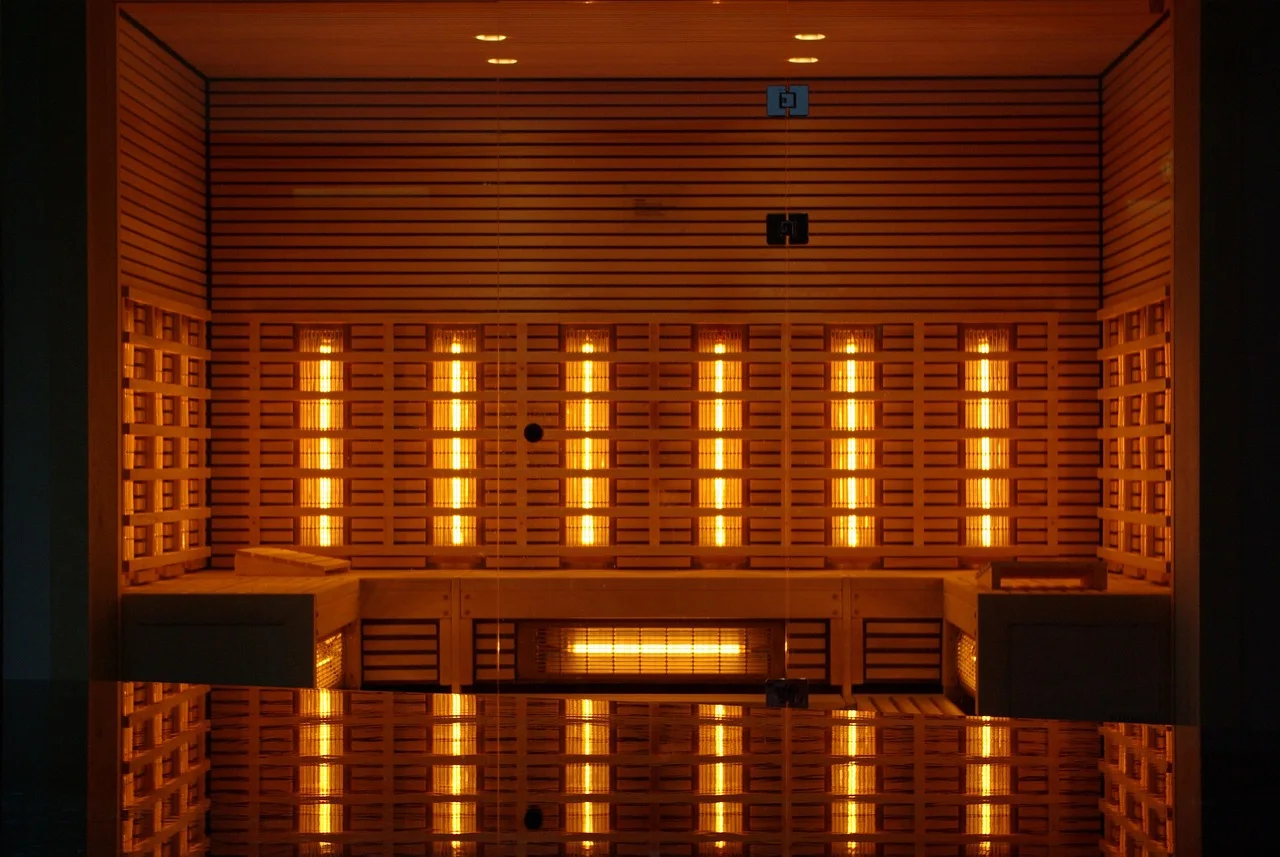
Infrared saunas at 50–60°C still raise core body temperature, though more slowly. The pregnancy guidance applies similarly: avoid in first trimester, use cautiously thereafter, talk to your provider. The lower air temperature is not a reliable safety margin given the longer typical session duration.
Steam rooms at 45°C with high humidity raise core temperature less than Finnish saunas but the high humidity reduces heat dissipation. Most pregnancy guidelines treat them similarly to saunas — caution in first trimester, mild use thereafter for normal pregnancies.
Hot tubs and jacuzzis are categorically more concerning than any dry-air sauna because of the immersion-driven heating. Most pregnancy guidance is firmer on hot tubs than on saunas.
The honest bottom line
If you're a Finnish woman with an established sauna routine, a normal pregnancy, and your obstetrician's blessing, brief and mild sauna use through pregnancy is probably fine and is supported by clinical experience and cohort data.
If you're a first-time sauna user trying it during pregnancy, or you have any pregnancy risk factors, or you're in early first trimester, the cautious answer — avoid — is the right one.
The decision isn't binary. It depends on factors no article can assess: your medical history, your pregnancy specifics, your sauna experience, your country's medical conventions. Use this guide to inform the conversation with your provider, not to replace it.
For non-pregnancy sauna use, our sauna safety tips and sauna routine for beginners cover the broader basics. The general rules apply to pregnancy too — they just have less margin for error.
Bottom line
Major medical guidelines generally recommend avoiding sauna in the first trimester due to neural tube defect risk from sustained core temperature elevation above 39°C. Second and third trimester guidance varies, with Finnish practice more permissive (brief, mild sessions for experienced users in normal pregnancies) and American/British guidance more cautious. Hot tubs are categorically riskier than saunas. Always discuss with your obstetrician or midwife before continuing or starting sauna use during pregnancy — the right answer depends on factors specific to your situation that no general guide can substitute for.
Talk to your doctor. When you have the conversation, the questions worth bringing: which trimester, what temperature is acceptable, how long per session, what symptoms should make you stop, and any pregnancy-specific risk factors that would change the answer.